Historical Review on Krishna Vanshi Yadava Jadon Rajput State Karauli
—
Medieval Period—-–
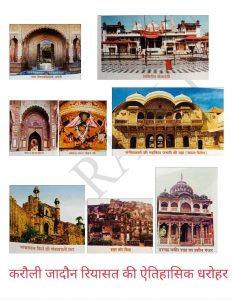
Maharaja Bijai Pal, a descendant of Sri Krishna, came from Mathura in 995 A.D. to the hill Mani, close to Biana and established himself there as a powerful monarch. In re-cognition of their descent, all the members of the Karauli family bear the appellation Pal, or protector (of cows, un-derstood), in contradistinction to the usual Rajput suffix of Singh, lion, which beast does not respect the sacred ani-mal. They claim to be the head of the Jadon Rajputs who belong to the Chandrawansh or family of the moon. The clan has always remained in the country of Braj round Muttra, and once held Biana which was taken from them by the Mahomedans in 1053 A.D. The foundations of the city of Karauli were laid by Arjan Deo in 1348. He also built the temple of Kalianji, of which the word Karauli is supposed to be a corruption. In 1454 the State was conquered by Mahmud Khilji, King of Malwa. Maharaja Gopal Das accompanied Akbar’s army to the Deccan and contributed greatly to its success. At Akbar’s request he laid the found-ations of the Agra fort, the soothsayers having declared thatthe hand of a descendant of Sri Krishna would ensure its sta-bility. This, together with the palace of Fatehpur-Sikri and parts of the Taj Mahal, is built of the famous Karauli red sandstone, which material is also largely used in the construc-tion of the houses and palaces in Karauli itself. After the conquest of Malwa by Akbar, the State became incorporated with the Delhi Empire. The greatest chief after Gopal Das was Gopal Singh, who succeeded in 1725 and was on good terms with Delhi, whence he received the coveted Mahi Maratib or fish insignia. On the decline of the Mogul power the State was so far subjugated by the Mahrattas that they exacted from it a tribute of Rs. 25,000 annually. This tribute was transferred to the British in 1817 by the Peshwa, and was remitted on the engagement by the Maharaja to furnish troops according to his means on the requisition of the British Government. At the same time the State was taken under British protection. In 1857, during the Mutiny, Maharaja Madan Pal rendered loyal service by sending troops against the Kotah mutineers. For this he was created a G.C.S.I.; his salute was raised from 15 to 17 guns, a debt of over a lakh of rupees due to the Government was remitted, and a dress of honour conferred.
Modern Period—
This State formerly paid a tribute of Rs. 25,000 to the Peshwa, by whom it was ceded to the British Government under the 14th Article
the Treaty of Poona in 1817. The Maharaja had made over the village of Machalpur and its dependencies to the management of the Peshwa in lieu of the tribute; but, as it was inconvenient for the British Government to take possession of villages so isolated, the tribute was relinquished in No-vember 1817, at the time of the conclusion of the Treaty (No. CXVI) by which the State of Karauli was taken under the protection of the British Government. In consideration of the relinquishment of the tribute the Maharaja, Harbakhsh Pal, was bound by the 5th Article of the Treaty to furnish troops at the requisition of the British Government according to his means. When the treaty was being considered the Maharaja wished for a guarantee that some of his old possessions south of the Chambal, then under the government of Sindhia, should be restored to him, subject to an annual tribute, if they should ever come into the possession of the British Government; this was refused. In 1825 when Durjan Sal rebelled against his cousin, Balwant Singh, the legitimate heir to the State of Bharatpur, the rebel was supported by the Maharaja of Karauli. After the fall of Bharatpur, however, the Maharaja made humble professions of submission, and it was not thought necessary to take serious notice of his conduct.
Beyond the adjustment of some boundary disputes between Karauli and Jaipur, no communications of any importance took place with Karauli till the death of Harbakhsh Pal in 1838. He was succeeded by his adopted son, Partab Pal, who died in 1848, leaving no son and no near male relative. In consequence of the factions which prevailed during the government of Partab Pal, a British officer was on four occasions deputed to Karauli to mediate between the parties, but without much success. Narsingh Pal, a minor, was adopted by the family as the successor of Partab Pal. Although but without much success. Narsingh Pal, a minor, was adopted by the family as the successor of Partab Pal. Although there were many disputes regarding the guardianship of the boy, there was none regarding his selection. The Karauli State was at this time in debt to the British Government, and the recognition of the adoption of Narsingh Pal was withheld till the first instalment should be paid. This debt was originally incurred by the Maharaja of Karauli to the State of Bharatpur, which was indebted to the British Government. In arranging for the liquidation of the Bharatpur debts Government gave credit for the amount due from Karauli, and took upon itself to recover it from that State. In 1844 the Karauli debt amounted to Rs. 1,54,312. Very advantagecus terms were given to the Maharaja; he was allowed twelve years to pay off the debt by instalments, and no interest was to be charged except on instal-ments remaining unpaid. Up to 1847, however, nothing had been paid, and a further period of a year and a half was allowed before the first instal-ment should be demanded. After some delay the young Chief offered pay-ment of the first instalment; but as it was not made unconditionally, and was advanced by a speculator for employment in Karauli, the money was not accepted. The factions at Karauli, however, were daily gaining strength, and, therefore, Government deemed it expedient to recognise the succession of Narsingh Pal, warning him at the same time that payment of the debt would be exacted; and as mediation between the factions had hitherto been unsuccessful, it was determined to send an Agent of the British Government to Karauli to control all parties and exercise the direct management of affairs.
Narsingh Pal died on 10th July 1852, having adopted the day before his death a distant kinsman named Bharat Pal. It was first proposed to treat the State as a lapse, but finally the adoption of Bharat Pal was recog-nized. In the meantime a strong party was formed in favour of Madan Pal, a nearer relative, whose claim was supported by the opinions of the Chiefs of Bharatpur, Dholpur, Alwar, and Jaipur. An inquiry was ordered, by which it was ascertained that the adoption of Bharat Pal was informal by reason of the minority of Narsingh Pal, and the omission of certain neces-sary ceremonies. As Madan Pal was nearer of kin than Bharat Pal and was accepted by the Ranis, by nine of the most influential Thakurs, by three-fourths of the minor feudal retainers of the State, and by the general feeling of the country, he was recognised in 1854 as successor to the Ka rauli Chiefship. The direct interference of the Political Agent in the internal administration was withdrawn and the Agency was removed in 1855; but Madan Pal was warned that, in the event of his failing in the regular payment of the annual instalment of the debt, then reduced to Rs. 94,312, one or more of his districts would be sequestrated for a time by the British Government till the whole of the debt should be liquidated.
Maharaja Madan Pal rendered good service in the mutinies of 1857. in consideration of which the sum of Rs. 1,17,000 due by him to the British Government was remitted, a khilat was conferred on him, and his salute was raised from fifteen to seventeen guns.
In 1859, in consequence of the pecuniary embarrassments of the State a Political Agent was deputed as a temporary measure to assist and advise the Maharaja in the adjustment of his debts. The Agent was withdrawn in 1861.
In 1862 a Sanad (see No. V) guaranteeing the privilege of adoption the Rulers of this State was granted by the Government of India.
In 1868 an extradition Treaty (No. CXVII) was concluded with the State for the mutual surrender of criminals in certain cases. This was modified, however, in 1887 by an Agreement (No. CXVIII), which provided that, in the extradition of offenders from British India to Karauli, the pro-cedure for the time being in force in British India should be followed.
Maharaja Madan Pal, who had been created a Knight Grand Com-mander of the Star of India, died in 1869, when his nephew, Rao Lachhman Pal of Hadauti, was recognised as his successor. Lachhman Pal, however, died before his installation, and the choice of the leading persons in the State fell upon Jaisingh Pal, a descendant of Kirat Pal, second son of Maharaja Dharam Pal, the common ancestor of the family. Jaisingh Pal was the nearest of kin to Maharaja Mádan Pal, with the exception of his own grandfather, who was still alive but who had resigned in his grandson’s favour the Raoship of Hadauti. The Rao of Hadauti is looked upon as the next heir to the Karauli gadi in the event of failure of direct heirs, The choice was confirmed by the British Government, and Jaisingh Pal was installed as Maharaja of Karauli.
Maharaja Jaisingh Pal died in December 1875, and the succession of Arjun Pal, Rao of Hadauti, then 48 years of age, was recognised by the British Government,
Sujan Pal, second cousin of Maharaja Jaisingh Pal, laid claim to the gadi of Karauli, and, on the rejection of his pretentions, to the Raoship of Hadauti. A reference to the principal Thakurs resulted in their unanimous decision that Bhim Pal, nephew of Arjun Pal, was the rightful successor to the Raoship of Hadauti.
On the 1st January 1877, at the Delhi Assemblage, the Government of India decided, as a mark of favour, to remit the interest due upon the amount of debt at the time owing by the Karauli State to Government. The Chief was also given 3 six-pounder guns by Government on certain conditions.
In 1881, owing to financial difficulties in the State, a temporary change was made in the administration by the transfer of the Chief’s authority to a Council with full powers to administer the State under the general control of the Political Agent.
In 1882 an Agreement (No. CXIX) was concluded with the Karauli Darbar for the suppression of salt manufacture in the State; for the preven-tion of the import and consumption of any salt excepting the on which British duty had been levied; and for the abolition of all State duties thereon. In return, the British Government engaged to pay the Maharaja Rs. 5,000 a year, and to deliver at Sambhar, free of duty and cost, 50 maunds of salt for his personal use. The Government subsequently agreed* to pay Rs. 694-15-0 annually to certain jagirdars as compensation.
In 1883 a set of rules for facilitating the arrest and surrender of crim-inals was introduced in the States of Karauli, Bharatpur and Dholpur with the approval of the Government of India, and about the same time the Karauli Darbar entered into a similar agreement with the State of Jaipur.
In 1884 the Darbar abolished all transit duties, save on opium and intoxicating drugs, throughout the State
Maharaja Arjun Pal died in July 1886, and was succeeded by his nephew, Bhanwar Pal, the Rao of Hadauti, on the 14th August 1886. The administration of the Karauli State continued, however, to be carried on by the State Council under the general supervision of the Political Agent; but in June 1887 the Maharaja was given, subject to certain conditions, increased powers. In June 1889 the Karauli State was cleared of all debts, and Maharaja Bhanwar Pal was invested with full powers in the adminis-tration of his State. He was present at the Delhi Coronation Darbar on the ist January 1903-
In 1903 the Government of India sanctioned the permanent adoption of the rules for the extradition of criminals, which had been introduced tentatively between the States of Karauli and Jaipur in 1883.
In 1904 the Darbar agreed to cede land free of charges for the con-struction and working of the Nadga-Muttra railway.
British currency was introduced into Karauli in place of the State coinage in January 1906.
.
In 1906, owing to the indebted condition of the State, the control over its finances was temporarily placed in the hands of the Political Agent, Eastern Rajputana States.
The area of Karauli is 1,242 square miles; and the population, accord-ing to the census of 1901, is 156,786. The revenue from all sources is about Rs. 5,00,190. The military force of the State consists (1905) of 259 cavalry, 1,774 infantry, 35 guns classed as serviceable and 21 as unservice-able, 32 artillery men and 28 armed police. These figures include irregulars.
The Chief receives a salute of 17 guns, which was finally approved in Her Majesty’s Order in Council, dated the 26th June 1867.
1-History of Mewat
By Dr. Aijaz Ahmad · 2021
2-The Cambridge Economic History of India,Volume 2, 2005
3-Against History, Against State
By Shail Mayaram · 2006,p.,110.
4-Memoirs on the History, Folk-lore, and Distribution of the Races of the North Western Provinces of India
Being an Amplified Edition of the Original Supplemental Glossary of Indian Terms · Volume 1
By Sir Henry Miers Elliot · 1869
The Modern History of the Indian 5-Chiefs, Rajas, Zamindars, & C: The native states
By Lokanātha Ghosha · 1879,p.210.
6-History of Medieval India
By V. D. Mahajan · 2007,p.71.
7-Glimpses of Bhāratiya History
By Rajendra Singh Kushwaha · 2003,p.17.
8-Migrations in Medieval and Early Colonial India by Vijaya Ramaswami
2017,p.,120.
9-The Jats, Their Origin, Antiquity, and Migrations By Hukam Singh Pawar · 1993,p.74.
10-The Rajputs History, Clans, Culture, and Nobility · Volume 1 By Rānā Muḥammad Sarvar K̲h̲ān̲ · 2005,p.177.
11-Journal of Indian History
Volumes 31-3.,1954,p.200.
12-Studies in History
The Jats, p ,1,By Ram Pande · 1974
13-Handbook on Rajputs
By A. H. Bingley · 1996.
14-Social and Political History of the Jats, Bharatpur Upto 1826,p185.
By Ram Pande · 2006.
15-Rethinking Early Modern India
2002,p.,80.
17-The Muslims of Indian Origin
During the Delhi Sultanate : Emergence, Attitudes, and Role, 1192-1526 A.D.p.,43.
By Sukhdev Singh · 2006
18-A Handbook of the Fighting Races of India.,p,195-196
By P. D. Bonarjee · 1899
19-Imperial Gazetteer of India …
Volume 14,p.,2,1908
20-A History of Rajasthan
By Rima Hooja · 2006,p.,401-404.
21-History and Culture of Rajasthan
From Earliest Times Upto 1956 A.D.
1999.,p,140.
22-A Comprehensive History of India: The Delhi Sultanat (A.D. 1206-1526), ed. by Mohammad Habib and Khaliq Ahmad Nizami
1970,p.,169.
23-Memoranda on Native States in India, Together with a List of Independent Ruling Chiefs, Chiefs of Frontier States, and Other Notables with Their Proper Forms of Address,p.100., 1911
24-Indian and Pakistan Year Book and Who’s who 1920,p87-89.
25-Rulers, Leading Families and Officials in the States of Central India By Central India · 1928.,p,8,12.
26-List of Ruling Princes, Chiefs and Leading Personages
Issues 2-13.,p,115-118,67,88.
By Rajputana (Agency), Charles Stuart Bayley · 1938
26District Census Handbook, Series 18, Rajasthan, Bharatpur District,1983,p,xix.
27-The New Cycle
Volume 16,p,332-335,1905.
28-Constitutional Development of Eastern Rajputana States,By D. D. Gaur · 1978,
29-The Evolution of Administration of the Former Bharatpur State, 1722-1947,By Kunj Bihari Lal Gupta · 1969
30-Notes on the Pathans of the Pathan Recruiting District
By G. P. Ranken · 1895.,p,191.
31-Caste, Tribes & Culture of RajputsBy A. H. Bingley · 1978,p,85.
32-Memoirs on the History, Folk-Lore, and Distribution of the Races of the North Western Provinces of India; being an amplified Edition of the original
Supplemental Glossary of India Terms By the late Henry M. Elliot. Edited, revised, and re-arranged by John Beames. In 2 Volumes. I
By Henry M. Elliot · 1869,p23,437.
33-Rajasthan [district Gazetteers].: Bharatpur ,By Rajasthan (India) · 1962,p.60.
34-Memoranda on the Indian States,1939,p.,90.
35-The Cambridge History of India
Volume 3,1928,p113.
36-Annals and Antiquities of Rajasthan (3 Vols),Or the Central and Western Rajput State of India By James Tod · 1987
37-The Cyclopædia of India and of Eastern and Southern Asia, Commercial Industrial, and Scientific
Products of the Mineral, Vegetable, and Animal Kingdoms, Useful Arts and Manufactures · Volume 3
By Edward Balfour · 1885,p1103.
38-The Tribes and Castes of the Central Provinces of India
Volume 4,By Robert Vane Russell · 1916,p.469.
39-Rajasthan District Gazetteers
Volume 10,By Rajasthan (India) · 1962.,p.,60.
40-Gazetteer of Ulwur
By Percy William Powlett · 1878
41-Mathura-Brindaban-The Mystical Land Of Lord Krishna
By F. S. Growse · 2000,p.36.
42-The Metaphysical Magazine
Volume 16,1905,p,333.
43-SETLEMENT OF THE DISTRST
By allahabad · 1875,p.,145.
44-The Ā-‘īn-i Akbarī
A Gazetteer and Administrative Manual of Akbar’s Empire and Past History of India · Volume 2
By Abū al-Faz̤l ibn Mubārak, Henry Sullivan Jarrett, Sir Jadunath Sarkar · 2010,p 201.
45-Who’s whoVolume 73
1921,p.1446.
46-Chiefs and Leading Families in Rajputana,By C. S. Bayley · 2004.
47-The Ain i Akbari
Volume 2,By Abū al-Faz̤l ibn Mubārak, Henry Sullivan Jarrett · 1993.,p.,256.
47-Tribes and Castes of Rajasthan
By M.A. Sherring · 2003
48-The Native Chiefs and Their States in 1877.A Manual of Reference By George Aberigh-Mackay · 1878
49-District Gazetteers of the United Provinces of Agra and Oudh
Volume 12,By United Provinces of Agra and Oudh (India) · 1911
50-An Ethnographical Hand-book for the N.-W. Provinces and Oudh
By William Crooke · 1890.
51-Rajasthan [district Gazetteers].: AlwarBy Rajasthan (India) · 1968
P.,47-48.
52-Report of a Tour in Eastern Rajputana in 1882-83 By Sir Alexander Cunningham · 1885,5-10
53-An Historical Sketch of the Native States of India in Subsidiary Alliance with the British Government By George Bruce Malleson · 1875,87.
54-Living Without Silver
The Monetary History of Early Medieval North India · Volume 1
By John Scott Deyell · 1982,p.130.
55-Mausoleums and Tombs of Rajasthan History and Architecture
By Ratanalāla Miśra · 2007,p.53,59.
56-Shodhak,Volume 7, Parts 1-3
19Braj
57-Centre of Krishna Pilgrimage
By A. W. Entwistle · 1987, 78.p.6
58-Changing Frontiers of Religion
By Gopal Krishna Agrawal · 1983,p.33.
59-Life and Culture in Medieval India,By Bhanwarlal Nathuram Luniya · 1978,p 111.
60-Journal of the Rajasthan Institute of Historical Research
Volume 4, Issue 2.By Rajasthan Institute of Historical Research · 1968,p 32.
61-Uttar Pradesh District Gazetteers: Lucknow
By Uttar Pradesh (India) · 1959,p.31.
62-Organiser,Volume 39, 1988.,p.6.
63-Memoirs of the Archaeological Survey of India,Issues 19-24, 1926,p.49.
64-The Evolution of Administration of the Former Bharatpur State, 1722-1947,By Kunj Bihari Lal Gupta · 1969,p.24.
65-Protected Monuments of Rajasthan
By Chandramani Singh · 2002,p.103.
66-Vishveshvaranand Indological Journal ,Volume 15,1977.p.78.
67-Memoirs of the Archæological Survey of Indi,Issue 23,1931,p.13.
68-Indian Princely Medals
A Record of the Orders, Decorations, and Medals of the Indian Princely States
By Tony McClenaghan · 1996,p.70.
69-Indo-IranianJournal,Volumes24-25,1982.,p.88.
70-Proceedings of the All-India Oriental Conference
Volume 28,1978.,p.412-413.
Bayana
71-The Sources of Mughal Architecture.By Shokoohy Mehrdad Shokoohy · 2020
72-Rajasthan [district Gazetteers].: Sawai Madhopur
By Rajasthan (India) · 1981,p 34-35.
73-Ancient Cities and Towns of Rajasthan:A Study of Culture and Civilization By Kailash Chand Jain · 2015
74-Rajasthan State Gazetteer: History and culture ,1995,p 57.
75-Rajasthan Through the Ages:
Auther-Dr Dhirendra Singh Jadaun
Village-Larhota ,Sasni ,Distt.
Hathras,U P .
Principal Govt. Girls College,Sawai madhopur ,Raj.