A historical Review on Ancient historical City Bayana Through the Ages —–
Bayana is the Yaduvanshi Rajput’s Kingdom.The YadavaRajputs are the ancient rulers of Braj .
The ancient history of the present Eastern Rajputana States and the Province of Agra, centres round Bayana, which nature and art combined to make into one of the most famous strongholds in India as early as the days of Hindu dominion.
Its position and importance—–
The ancient historical City Bayana is situated on an eminence in a small plain, between two ranges of hills,meaning more or less parallel to each other and in a direction from North-east to South-west, close to the left bank of the Gambhir river, a tributory of the Ban ganga. It is situated approximately about 50 South of Bharatpur city, 110 km East from Jaipur, and 70km to South-West of Agra and 160 km south of Delhi. It is in the Delhi -Agra -Fatahpur Sikari tringle , now the hub of modern development in northern India.The historic town is on the eastern foot of a hill ,while the fort stands 6km to the west of the town Bayana , on the summit of a hill at a height of between 250 and 350m.In the last decade of the 15th century and during the region of Sikandar Lodi a new town known as Sikandra ,was planned in the fields between fort and the old town ,but was probably never completed.
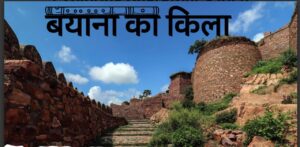
Above the town on the South-West rises the famous fort of Vijeymandirgarh. This hill fort of victory stands on the Eastern end of a short range of hills which runs nearly perpenidicular to the standstone ranges of Karauli and Fatepur Sikri .Carlleyle who visited Bayana in 1871 A.D. ,states that the ancient name of this that was Santipura and it is said to have been built by an ancient dynasty of kings who were the descendants of Banasur the son of Raja Bal. The name “Santipura may be connected with the locality but that the ancient and original Hindu name of this iron castle was Santipura is not evidenced by any of the records available.
The importance of the Bayana fort—-
Bayana fort situated strategically as it is, cannot be exaggerated. Every King of Delhi whose power extended to the borders of Rajputana felt himself bound to garrison this fort. The Moghal Emperor Babar writing in 1526 , describes it as one of the most famous forts in India. During the reign of Sher Shah a division of the army was stationed at Bayana with a garrison of 500 match lock-men, in the fort .It is mentioned in Ain-i-Akbari that in former times it was the capital of a Province of which Agra was but a dependent village. In fact, in those days, Bayana may be considered to have been a capital city next in importance only to Deihi. In ancient days Bayana was certainly a place of great consequence.
Successive conquerors, both Hindus and Muslims, devoted their energies to the streagthening of this splendid natural stronghold, and it is now a curious medley of Hindu and Mohamunedan relics, the most important being a red sandstone pillar called BhimLat or the ‘Oilman’s Lat(3).This can be seen from a great distance. This monolith pillar, bears the following inscription of the Varika King Vishunuvardhan dated the year 428 Vikram Samvat, or A. D. 371-72.
(1) Kritau pundrikai yopoyam pratishtha- pitassu pratishthit rajayea nam dheyen.
(2) Shri vishnu vardhan vartiken yashovardhan satren (satpatren)
(3) Vashorat talpautren viyaghrarat sat- pautren shri yogya dharmaschyobhu- dayae yashah kulvansh bhag bhogya bhivridaye.
(4) Shidhi raste pashtirastu shantirastu jeevputratyisatyapati kama vaptirasta shradha vitretayit.
“Varike King Vishunuvardhan, son of Yashodherman, son of Yashorat, son of Viyaghrarat, erected this pillar in Vikram Sanvat 428, in the month of Phalgun, in honour of a ritual ceremony of Hindu ‘Yag’ or Havan performed by him”.
That the fort of Bayana or Vijeymandirgarh was regarded as being of the greatest strategical importance by the rulers of Northern India and that much blood was shed for its possession in the past is manifest from the millions of tombs scattered about in the neighbourhood of the town. The grand old fort still remains with its picturesque gates and lofty lowers but all life has departed from it.
Of Bayana, Abul Fasal says — ‘This town is the burial place of many illustrious men’. No doubt this statement is true but only a few great men like Abu Bakr Kandhari and others who had successfully stormed Bayana for the first time in the 11th century A. D. are remembered and honoured to this day.
The origin of it’s name—-
The ancient name of Bayana was Shripath or Shriprastha. The history of this name can be traced back to the times of Mahabharat when there were five important capitals in Northern India. They were Viaghraprasth, the modern, Baghpat, Talprasth, the modern Taraori, Sthanprastha the modern Thaneshwar, Meru Prasth, the modern Maripal and Shriprastha, the medieval Shripath or modern Bayana.
Some writers of note following Mr. Elliot mentioned that the ancient name of Bayana was Thangar a statement which has no historical basis to support it. The fort of Thangar or Thankar as mentioned by Hasan Nizam , and Minhajus Siraj , lies some 20 miles from the fort of Bayana and it was there that Mohammed Ghauri in the year 1195 A.D ., marched and the Centre of “Idolatry and perdition became the abodeal of glory splenidour”. In the early part of the 11th century A.D. Tahan Pal after the death of his illustrious father Vijay Pal, has transferred the Capital from
Bayana to a newly erected city called after him ‘Tahangarh” or “Thangarh, still standing in ruins, Therefore, there is historical warrant to say that the ancient name of Bayana was Thangarh.
That the ancient name of Bayana was Shripath or Shriprastha, can not be doubt . Fortunately there are three inscriptions available which bear testimony to this fact. There is a long inscription, embedded the pavement of Ukha Mandir which was built in 955 A. D. by queen Chitralekha daughter of King Rajayika of Bayana “The inscription’ is in the Sanskrit language and in Nagri characters of Katita type in line 21, there are the worte Drammaitritayam datte pratidivasa sripath-sthamandapika, which seem show very clearly that the ancient name of Bayana was Shripatha.”
Another important inscription in which Bayana is given the ancient name of Shripatha is found on the memorial of a Jain teacher Maheshwar Suri , whose death occurred on Monday the 2nd Bhadoon Vikram Samvat 1100, as is known from the last line of its first stanza .Shri vijyadhiraj nirptea Shri shripathayampuri
and lastly there is the third instance in another Bayana inscription which commments “Om siddhih samwat 1503 varshe ashadha vadi samau dine Shri Shripathayam .
General Cunningham gives the ancient name of the town as Pathayampuri and adds “This believe to have been the original name of the place and also of the present name of Bayana, for, by the simple elison of ‘Th’ Payampuri, or Bayanpur, might easily be shortened to Bayana.” But no proof is forthcoming to show definitely that the ancient name of Bayana was Pathayampuri. It is simply a mistake originating in a total misreading of the word Shri shripathayampuri” which occur in the last line of the first stanza of the memorial of Maheshwar Suri.
If the ancient name of Bayana was Shripath then how is it that the modern Hindu name of the town came to be pronounced as Byana or Bayana? How are we to account for the sudden disuse of the ancient name and the rise of the modern name “Bayana’ which is depicted as having no true history, about its origin , apart from legendry anetydotes that are current in that city of glory and in its neighbourhood? The antiquity of this modern name does not go beyond the 12th or 13th century A. D., the period when Bayana saw it’s darkest days and lost it’s independence.
These are some of the problems that often can front a historian who under takes the difficult task of investigating into the ancient history of Bayana.
The pioneer in the field was Mr, Carlleyle who investigated Bayana in the Eighties of the last century. He says that the “Ancient name of Bayana was Banasur “. “The first syllable “Ban ‘ of Banasur may origi naily have been “Van’, which means “Forest” or “jungle”. Therefore “Vanasur” might means the chief of the Forest or a King of the Forest country which would be a geting title for a king or chief of Bayana as the country aroundBayana had been at one time a great forest.”
He goes on to say that if there exists a similarity between the names ‘Banasur’ and ‘Bhainsasur ‘ and if the termination “asur ” is taken away, the word “Bhains” or “Bains” are left which might have been the real ancient name of Bais tribe; for the letter ‘N’ in the word ‘Bhains ” or ” Bains ” would naturally be eliminated and lost in the vulgar speech of the country. “The present name of the town Byana or Bayana may be a corruption of contraction of ‘Bhainasana’ or ‘Bainsana” which again night be a short or quickly spoken form of Bhains-awana which would mean the screen or shelter or enclosure of the “Bhiains’ or ‘Baina ‘ or Bais ‘ tribe” which then resided in the country around Bayana and in the neighbourhood of Agra.
Mr. Carlleyle’s derivation of the ancient name from Banasur may be dismissed by quaoting the words of Mr. Fleet , ” his (Carlleyle ‘s ) arguments in support of it are based on nothing except his inability to recognite the difference between ” Bana “an arrow, ‘Vana, a forest; banah, an arm bhains,” a buffalo and “Bais the name of a tribe and between ‘asura’ a demon; Sura, a hero, “Suri ‘ a Jain teacher or learned man and ‘ Surya’, the Sun .
Besides this the word ‘Bhains’ is not of Sanskrit origin. In case the word had been ‘Mahis’, it could be taken for granted that” MahisarSaur who was killed by Goddess Devi, might have been one of the chiefs of Bayana. Carlleyle is totally wrong when he describes “Bhainsasur ” as the word from which the real ancient name of ‘Bains’ tribe can be traced. One would laugh at his peculiar derivation in dropping the letter ‘N’ from ‘Bhains’ or “Bains and creating a new word “Bais”, a name of a tribe that is said to have resided somewhere in the vicinity of Bayana and Agra. Pioneer in the field and a foreigner as he was, he could not but rely on the legends which local residents are only to eager to relate to foreign visitors.
The real origin of ‘Bayana’ is to be found in the corruption of the name “Banya’ from the Sanskrit word ‘Banya ‘or ‘ Van’. This corrupted form seems to have originated in the vulgar speech of the country and later on adopted by Muslim writers . ‘ Van’, in Sanskrit means wild or dense forest. The word “Banya also has the same meaning. If , we care to consider the physical features of the country of Bayana and its suburbs we will not be left in doubt about the fact that the city at one time must have been surrounded by impotetrable and dense jungles full of wild beasts and snakes. There is a river also called ” Bana” flowing in the vicinity of the town. As “Van” or “Ban’ means forest Bana’ seems to be the appropriate name given to this river of the forest.
That there certainly existed a city called ‘Banias’ or ‘Banian’ or ‘Bany an’ in Northern India even in the 13th century AD. is amply corroborated by the statement of Minhajus Siraj, the author of the Tabakar-i-Nasiri, when he says that in A.H. 636, Iltutmish led the armies of Hindustan towards Banias or ‘Banian.” Banian or Banias of Minhajus Siraj is no other than this modern Bayana which then commanded the unique position of controlling the routes to Rajputana, Gujrat and the Deccan. Major Raverty’s is wrong in locating the place ‘Banian’ or “Banian” of Minhajus Siraj, in the hill tracts of the Sind Sagar Doab or in the country immediately west of the Salt range. That the name ‘Bania’ has been corrupted into ‘ Banias’ or ‘Banian’ by Muslim authors should cause no surprise to us when we know that they have written Bhatinda as ‘Pathinda’ or ‘Tarhinda’ and Gawalior as Gawaliyur.
Therefore it is from the Sanskrit word “Banya and not from ‘Baansu’ r that the modern name Byana or Bayana has beef derived. Likewise it would be a mistake to suppose that Bayana derived its name from any association with the residence of the “Bais’ tribe in the nighbourhood. As Sanskrit tell into disuse and the Muslim Invaders must have found the original sanskrit name Shri Shripathampuri difficult to pronounce, the name felt into oblivion and a simpler ‘Banya’ in its corrupted form ‘Banya Banias’ or ‘Banyas or Banyan’ ‘Baynian’ or ‘Bayans’ gained currency in the vulgar speech of the country.
The Yaduvanshis of Bayana-Sripatha and Karauli —-
A Yadu /Yadava dynasty or Yaduvanshi lunar race Rajput family ruled at Sripatha or Bayana in the former state of Bharatpur in Rajasthan.. Upto 955 A. D, Sripatha appears to have been ruled by the Surasena dynasty. Either this Surasena dynasty or one of its off-shoots might have been designated as Yadava. Sursena was himself a Yadava, or a Yaduvanshi lunar race Rajput ruler.
The list of king so this dynasty is verified by the epigraphic records. These records prove that the kingdom of this dynasty, comprised the old Bharatpur State and the Mathura District of U.P. King Jaitapala of this list is placed in the first half of the eleventh century. His successor was Vijayapala, who is identified as king Vijaya of the Bayana inscription, dated KB4146 (1044AD). Vijayapala repulsed the Muslim invasion according to Vijayapala Raso’.
Vijayapala’s successor was Tahanpala KB 4195-4251 (1093-1159AD) who according to tradition, built the fort of Tahangarh, 23 kilometer south of Bayana. Tahanapala
was followed in succession by Dharmapala, Kunwarpala and Ajayapala. It is known from the Mahaban prasasti (memento), found near Mathura, that
Maharajadhiraja Ajayapala ruled in KB4252(1150AD).An inscription of Haripala, dates KB 4272 (1170 AD), has been found at Mahaban. Haripala was succeeded by
Sohanpala. An image inscription of the reign of Sohanapala deva, dated KB 4294 (1192AD),has been discovered at Aghapur,in the old Bharatpur State. Sohanpala’s successors was Kunwarpala who, was the predecessor of Ajayapala as mentioned earlier ,Taj-ul-Ma,asir states that in KB 4298 (1196AD) Mu,izz-ud-din Mohammad Ghauri defeated Kunwarpala ,the Rai of Tahangarh after a furious battle when he handed the fort over to Baha-ud-dinTughril .Anangapala may be taken to have ascended the thorne after Kunwarpala.Anangapala was followed in succession by
Prithvipala, Rajapala and Trilokapala ,the last of whom be placed at the end of the thirteenth century A.D. Raja Arjunpala ,KB 4429 -4463 (1327-61 AD ) son of Gokuldeva , was one of the greatest kings of this dynast. By defeating Miyan Makkhan of Mandrayal, who was unpopular in the region ,he again got a foothold in his home territory . He further established his authority over his kingdom by suppressin Minas
and the Panwar Rajputs.He is also credited with having founded the town of Kalyanpura (Karauli )in 1348 A.D.,and making it beautiful with mansions, lakes, gardens and temples (Elliot,
Vol. V, 98, Gahalot , History of Rajputana, pp.601-2 ). Thus the whole tract of Brij was under the rule of Yaduvanshis till the end of 14th century (A Comprehensive History of India ,edited by Mohammad Habib Khaliq Ahmad Nizami ,pp.838-39).
1-A.S.Indian . ,Vol.,VI.
2-Babar’s Memories.
3-Elliot,Vol ,IV.
4-Elliot Vol,II.
5-Tajal-Ma-Asir ,Elliot ,Vol.,II.
6-Tabaqat -i-Nasiri ,Elliot ,Vol.,II.
7-Indian Antiquary ,Vol.,XIV.
8-Indian Antiquary ,Vol.,XV.
9-J.A.S.Ind.Vol.,XX.
10-A.S.Indian.Vol.,I.
11-Indian Antiquary ,Vol.,XIV.
12-Reverty’s Transition of Tabaqat-i-Nasiri .,Vol.,I.,p.423.
13- A. Cunningham, Archaeological Survey of India, Report of a Tour in Eastem Rajputana 1871-72 and 1872-73, Vol. VI (reprint, Varanasi 1966);
14- Chandramani Singh (ed.), Protected Monuments of Rajasthan (Jaipur 2002);
15- K.C. Jain, Ancient Cities and Towns of Rajasthan (Delhi 1972);
16-Rajeev Bargoti, Bayana-A Concept of Historical Archaeology(Jaipur 2003).
17-Archaeological Survey of India, Annual Report on Indian
Epigraphy for 1955-56, No.D, 114(reprint, New Delhi 1986), (2)
18-K.K. Sehgal (ed.). Rajasthan District Gazetteers, Bharatpur District (Jaipur 1971) .
19-Archaeological Survey of India, Jaipur Circle, Jaipur.
20-Shokoohy ,M and Shokoohy ,N.H Bayana:The source of Mughal Architecture.
21-Bayana ,atihasika Sarvekshana by Damodara Lal Garg, 2005.
22-History of Bhurtpore by Babu Jwala Sahai ,Nazim of Deeg ,1898.
23.A.C.L.,Carlleyle in the Archaeological Survey of India .Report for 1871-72,Vol.IV.
24-The Forts of Rajasthan
By Rita Sharma, Vijay Sharma · 2020.
25-History of Mewat
By Dr. Aijaz Ahmad · 2021.
26-A History of Rajasthan
By Rima Hooja · 2006
27-The History of India, as Told by Its Own Historians. The Muhammadan Period
Ed. from the Posthumous Papers of the Late Sir H. M. Elliot …
By Sir Henry Miers Elliot · 1867
28-Architecture in Medieval India
Forms, Contexts, Histories
2001
29-Proceedings
Volume 60
By Indian History Congress · 2000
18-Journal of Indian History
Volumes 32-33
1955.
30-Epigraphia Indica
Arabic and Persian supplement
1968
31-Glimpses of Bhāratiya History
By Rajendra Singh Kushwaha · 2003.
32-Military History of India
By Hemendra Chandra Kar · 1980.
33-Proceedings – Indian History Congress
By Indian History Congress · 1999.
34-Rajasthan
By Mathurālāla Śarmā · 1972.
35-Rajasthan
Lesser Known Destinations
1999
36-Mausoleums and Tombs of Rajasthan
History and Architecture
By Ratanalāla Miśra · 2007
37-Rajasthan District Gazetteers: Sawai Madhopur
By Rajasthan (India), K. K. Sehgal · 1962
38-Carlleyle A.C.L.,Reports of a Tour in Eastern Rajputana in 1871-72.and 18772-73,ASIR, VI ,Calcutta ,1878.p.40-77.
39-Ibn Battuta (Ar),pp.545,557.
40-Muntakhab al-tawarikh (pers),I.,p.322.
41-Tabaqat -i-Akbari (pers)I.,p.334.
42-ASIR,XX.,pp.88-92.
43-Tarikh -i-Mubarak Shahi ,written in c.1434.,p206.IV.,p.62.
44-Muhammad b.Abd al-jabbar al -Utbi ,Al-tarikh al Yamini ,II.,pp ,272-75.
45-Al-Utbi,Al-tarikhal Yamini ,II.,pp.272-75 ,Juriadiqani ,Tariuma-yi-tarikh-i-Yamini ,p.379.
46-Constitutional Development of Eastern Rajputana States
By D. D. Gaur · 1978.
48-Gazetteer of the Persian Gulf, ʻOmān, and Central Arabia: Historical. 4 v
By John Gordon Lorimer · 1970
49-Imperial Gazetteer of India
Provincial Series · Volume 23,
1908.
50-Provincial Series
Central Provinces, 1908.
51-Gazetter of the Karauli State by Captain Percy .W .Powlett.,1874,
52-Mediaeval History of Rajasthan: Western Rajasthan
By Rajvi Amar Singh · 1992,p.1396
53- Rajputana -Ka-Itihas by J.S.Gahlot.
54-Reports on the administration of the Karauli State for the Sambat year (1902-1903 to 1939-40. A .D.)Rajasthan Archives Bikaner.
55–Sherring M.A.The Tribes and Castes of Rajasthan together with description of the sacred and operated places of historical value .
56-Living without Silver .The Monetary History of Early Medieval North India .By Johan Scott Deyell ,1982,p.130.,196.
57-Life and culture in Medieval India .By Bhanwarlal Nathuram Luniya ,1978,p.111.
58–Rajasthan State Gazetteer :
History and Culture . 1995,p.57.
59-A Comprehensive History of India :The Delhi Sultnate .( A.D. 1206-1526 ) Ed By Mahammad Habib and Khaliq .Ahmad Nizame ,1970,p.838.
40-Mediaeval History of Rajasthan : Western Rajasthan .By Rajvi Amar Singh ,1992,p.1391-1396.
60- -Madan Mohan :An Encharting Saga.By Sushant Bharti .,2024,p.1
61-Rajasthan Studies by G. N.Sharma .,1970,p 10.
62- Rajasthan Through the Ages: From the Earliest Times to 1316A.D.By Dasharath Sharma ,1966.,p.43,287,699.
63-The Tribes and Castes of the North-Western Provinces and Qudh .By William Crooke ,19
Author Prof.Dr Dhirendra Singh Jadaun ,
Village-Larhota near Sasni
District-Hathras(UP)
Principal Government Post Graduate Girls College ,Sawaimadhopur
,Rajasthan-322001